Pentagon adds ChatGPT Mil and Grok for Government
The Department of Defense added OpenAI’s ChatGPT Mil and Starshield AI’s Grok for Government to GenAI.mil, opening accredited generative-AI tools to DOD personnel.
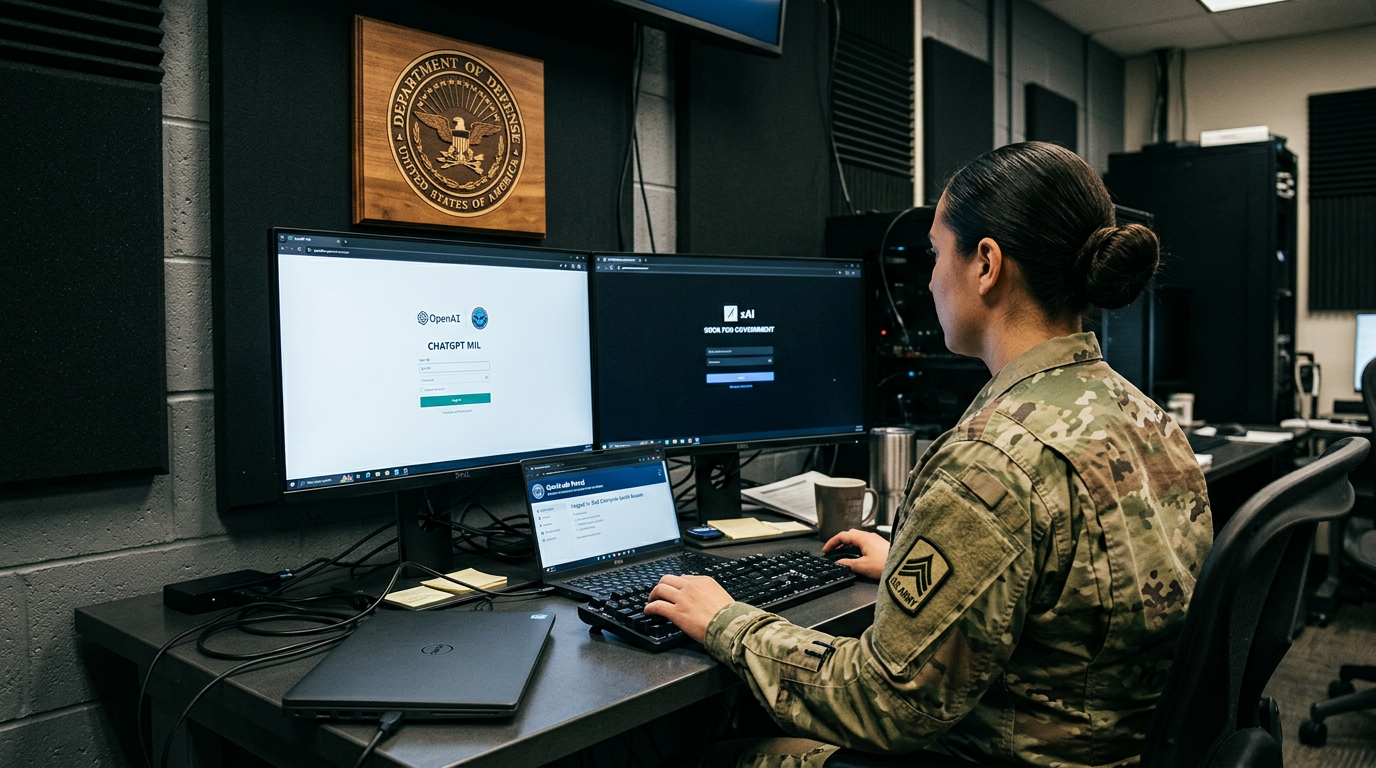
The Department of Defense added OpenAI’s ChatGPT Mil and Starshield AI’s Grok for Government to its GenAI.mil platform, making two CUI‑authorized generative‑AI tools available to DOD personnel for official work.
On Aug. 31, 2026, the Pentagon opened the software on GenAI.mil; the department says the platform now counts roughly 1.7 million onboarded users. The additions are framed as enterprise-grade models for planning, logistics and administrative tasks across the department and among its workforce and contractors.
GenAI.mil is the Pentagon’s curated catalogue of accredited generative models and services that meet specific handling requirements for controlled unclassified information (CUI). By adding ChatGPT Mil and Grok for Government, the department has expanded the set of vendor-provided, government-authorized models available through that central portal, officials said. Military Times reported the rollout and provided additional coverage of the user-facing launch.
For HR and workforce managers inside DOD, the change redraws the landscape for routine work processes. Tools positioned for planning and logistics can speed administrative workflows, document drafting and internal coordination; human resources leaders will need to update policies on permissible use, training requirements and audit trails when employees incorporate these models into day-to-day tasks.
The move reflects a wider public-sector push to standardize generative‑AI access rather than leave deployments to individual units or contractors. Over the past two years several federal agencies and large public‑sector employers have sought accredited, CUI‑capable models to limit uncontrolled data flows and to centralize governance. Centralized platforms like GenAI.mil let the department impose consistent access controls, but they also shift the governance burden to enterprise teams who must define role-based permissions and oversight.
The department and the vendors provided technical framing for the tools but stopped short of full operational detail. Officials did not disclose specific audit results, independent bias or safety certifications, or the underlying legal assessments that authorized the models for CUI. Pricing and licensing terms for wider contractor use were not released, and the department did not publish granular information on data retention, telemetry, model fine‑tuning controls or how vendor updates will be vetted before reauthorization.
That lack of detail leaves several practical questions for HR and compliance teams: how will training records and usage logs be integrated into personnel files, what approvals contractors must obtain to use the services, and how supervisors will handle output review and attribution in performance assessments. The department’s announcement also did not clarify whether the tools are cleared for any classified workflows; the authorization cited applies to controlled unclassified information.
The additions to GenAI.mil are likely to shape how artificial intelligence is embedded across a large, hierarchical workforce. For DOD HR leaders and their counterparts in large government contractors, the immediate work will be operational: updating acceptable-use policies, defining supervision and audit processes, and rolling out targeted training so employees use the new tools in ways that align with security, privacy and performance expectations. As the department accumulates usage data, those governance decisions will determine whether centralized model access improves productivity, compliance or both.