ONS publishes 'AI in UK businesses' analysis
The Office for National Statistics published an official analysis on 20 July 2026 using BICS that maps UK business adoption of AI and early labour-market effects.
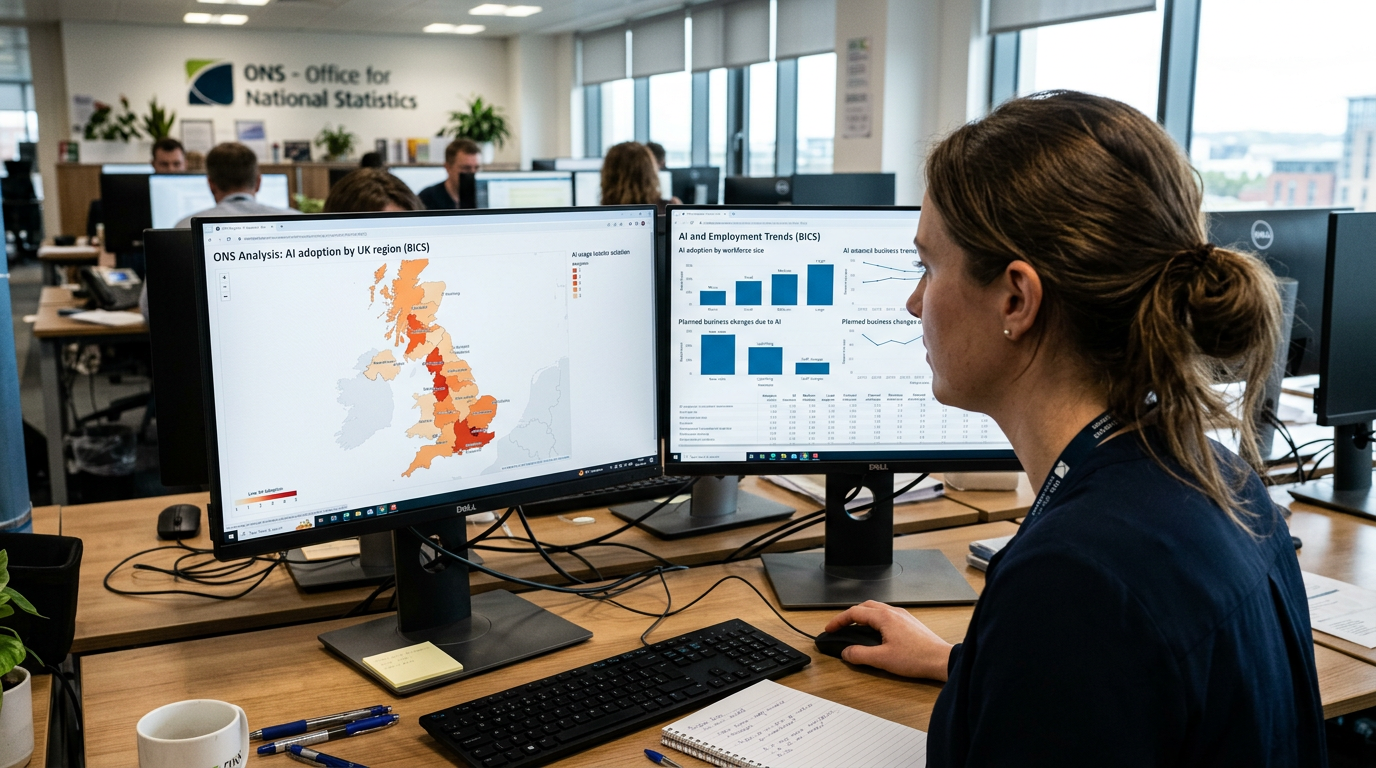
The Office for National Statistics has published an official analysis titled "AI in UK businesses" that uses the Business Insights and Conditions Survey to map how firms across the UK are adopting artificial intelligence and the early effects on the labour market.
Published on 20 July 2026, the ONS analysis draws on responses gathered through BICS to chart reported use of AI technologies — from basic automation and people-analytics to generative systems — and to identify which sectors report higher adoption and where automation pressures on roles are emerging.
The report provides a UK-specific snapshot for HR teams and regulators, describing not only headline uptake but also patterns in use cases and early signals of workforce change. It distinguishes between different kinds of AI-related activity within firms and links those self-reported practices to short-term labour-market outcomes, giving employers a baseline measure of where generative AI and analytics tools are already being deployed.
For HR leaders, the analysis functions as an empirical check on anecdote and vendor claims. The ONS presents evidence that adoption is uneven across industries and that some workplaces are already reporting changes to recruitment, skills needs and routine task allocation. That pattern aligns with what people-analytics and talent teams have been tracking internally: new tools are reshaping job design, prompting reskilling programmes in some areas while concentrating automation pressure in others.
The publication arrives at a time of heightened regulatory attention to workplace AI. UK regulators and policy bodies have been tightening scrutiny of algorithmic decision-making, data protection and employment impacts, and the ONS dataset gives them a timely, nationally representative input for policy calibration. For the regulator community and departments responsible for business and labour policy, the analysis supplies measured, repeatable statistics that can inform guidance, inspection priorities and future statutory interventions.
The ONS methodology — using BICS — makes the analysis repeatable but also presents limits for interpretation. While the report maps reported practice, it does not assign causation between AI adoption and long-term job losses or productivity changes; nor does it substitute for firm-level case studies that trace outcomes over time. The ONS itself frames the work as an early statistical assessment rather than a definitive audit of business AI strategy.
Notably absent from the analysis are granular disclosures about governance and compliance within adopting firms. The report does not provide firm-level information on internal AI governance structures, the presence or results of bias audits, or detailed evidence of conformity with data-protection or equality obligations. That gap matters for HR and compliance teams because reported use of AI offers limited insight into whether employers are carrying out impact assessments, retaining audit trails, or applying established mitigation for algorithmic bias.
For HR leaders planning next steps, the ONS analysis establishes a public benchmark against which to compare their own adoption and people-impact assessments. As companies move from pilot to scale, the statistical picture will help shape practical choices on recruitment, retraining and workforce redesign — and it will supply regulators with the empirical basis to target guidance or enforcement. The next iterations of this work will be watched closely: employers and policy-makers alike will need repeated, detailed measurements to track how the early patterns identified by the ONS evolve as generative AI and people-analytics tools become more widely embedded in day-to-day HR decision-making.