Musicians' Union demands consent, pay for AI music
The Musicians' Union launched a campaign on 23–24 July 2026 calling for consent, credit and fair pay when music is used to train AI or when AI generates music.
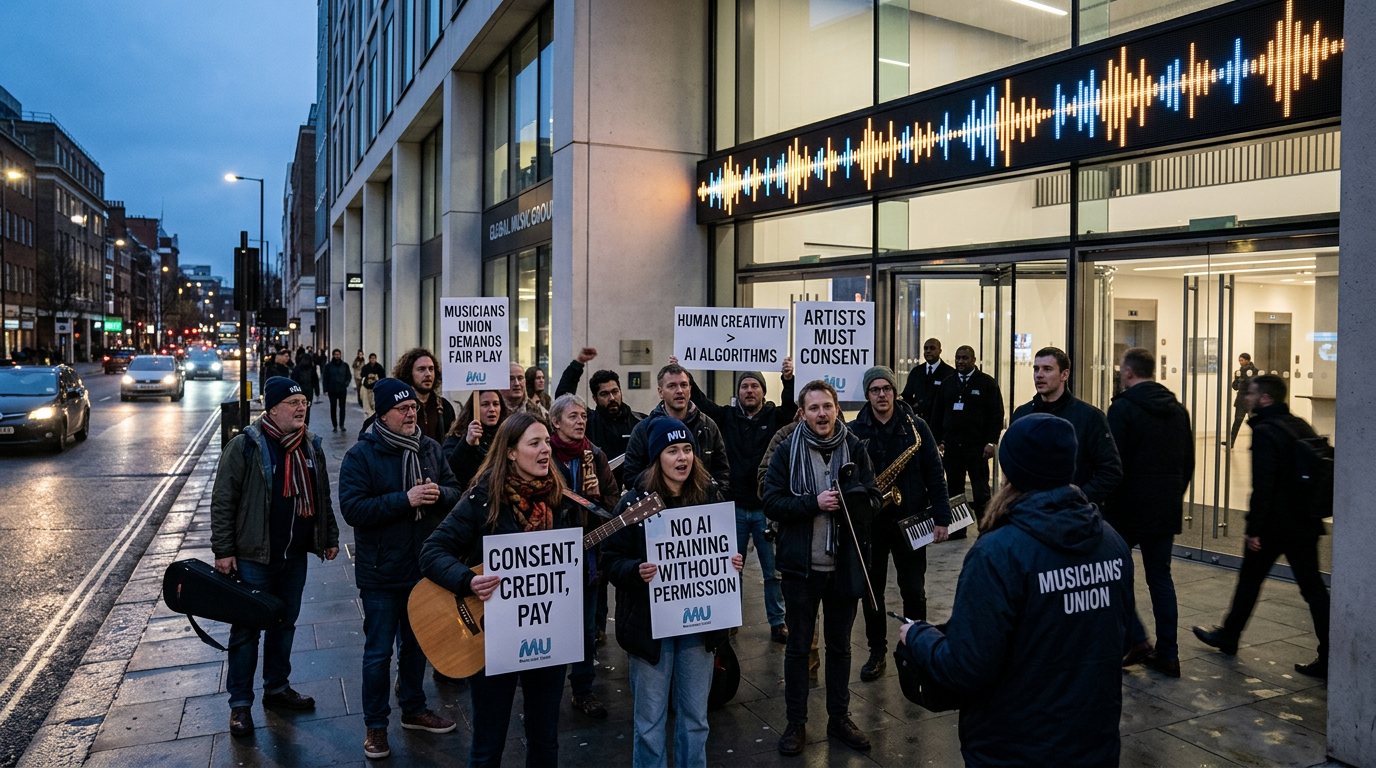
The Musicians' Union has launched a campaign calling for creator consent, recognition and fair remuneration when music is used to train artificial intelligence systems or when AI produces new music.
Updated on 23–24 July 2026 on the union's website, the campaign sets out three core demands: that musicians and other creators must give informed consent before their work is used to train models; that they receive recognition or credit where their material has contributed to AI-generated outputs; and that they receive fair pay when AI repurposes their recordings or compositions. The union frames the push as an effort to protect members' rights and incomes in a market where music is increasingly used to train commercial tools.
The Musicians' Union positions the campaign as both a rights and a bargaining issue. It says members should not be treated as an unknowable data source and that existing licensing and employment arrangements need updating to reflect the use of creative work in model training and synthetic output. The union's material includes guidance for members on how to assert consent and seek remuneration, and it encourages collective action to create industry-wide standards.
The move is a UK union-led example of collective action on AI data rights and remuneration, and it arrives amid wider debates about how creative labour should be treated in the age of generative models. Rights holders, creator collectives and a number of industries have increasingly questioned whether existing licensing frameworks and contracts adequately cover large-scale data scraping and model training, and trade unions are beginning to put those concerns into industrial campaigns rather than leaving them solely to litigation or regulation.
For HR and employers in music, media and tech, the campaign highlights contractual and procurement risks. Labels, streaming services, production houses and AI vendors that rely on music to train models will face pressure to demonstrate consent processes, record-keeping and payment flows. For session musicians and freelance composers—who commonly work under short-term or work-for-hire agreements—the union's demands raise immediate questions about legacy contracts and whether past recordings can be retroactively claimed as training data.
The Musicians' Union's campaign is light on implementation detail. It does not set out specific pay rates, a methodology for apportioning remuneration, or an enforcement mechanism should companies continue to use material without consent. The campaign also does not spell out how cross-border data flows would be handled, whether publishers or labels would be liable, or how disputes over provenance and contribution would be adjudicated. The union's material offers member guidance but stops short of a formal bargaining timetable or a coordinated legal strategy.
Looking ahead, the campaign signals that workplace AI policy will increasingly intersect with sector-specific bargaining and intellectual-property negotiations. If the union secures commitments from major rights holders or platforms, HR teams and legal departments will need to rework contracts, supplier terms and pay processes to account for consent and additional remuneration streams — shifting some of the responsibility for governance of training data from technologists to employers and bargaining partners.