HR Dive: HR AI agents still need human oversight
HR Dive reports companies deploying AI agents for HR tasks still require human oversight amid risks in restructurings, people-analytics governance and planning.
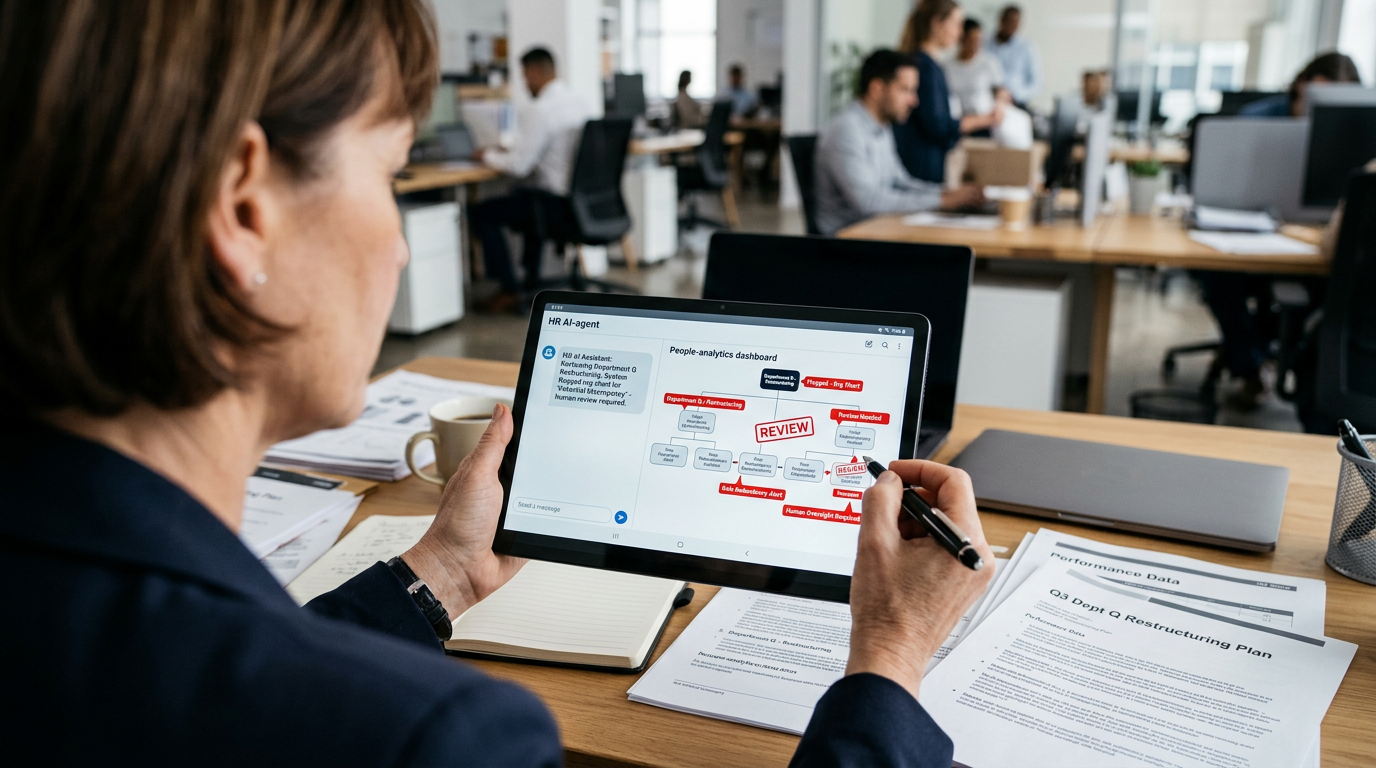
Companies that are embedding AI agents into HR workflows are continuing to rely on human oversight, according to a report published by HR Dive. The reporting finds firms use agents for casework and triage but experts and internal reports warn these tools cannot fully replace human judgement for sensitive people decisions.
HR Dive published its piece on Aug. 28, 2026, outlining how HR teams have begun deploying conversational and autonomous agents to manage routine inquiries, surface candidate or employee information and route matters to specialists. The outlet quotes HR leaders and analysts who say the technology can speed responses and free HR professionals for higher‑value work, but also raises operational and legal risks that require human intervention.
Sources cited in the reporting flagged three core areas where human oversight remains critical: AI‑driven restructurings, governance of people‑analytics platforms, and strategic workforce planning. In restructuring scenarios, the report warns that automated recommendations for role eliminations or redeployments can miss contextual factors such as contractual protections, collective‑bargaining obligations or business‑critical institutional knowledge—matters that demand HR and legal review before action.
Similarly, people‑analytics governance emerged as a recurring concern. Experts told HR Dive that models trained on historical HR data can replicate past biases or amplify skewed signals unless human teams set clear acceptance criteria, monitor for disparate impact and retain decision rights over model outputs. For workforce planning, the report notes that agents can generate scenarios and forecasts, but leaders must interpret assumptions and reconcile model suggestions with strategic priorities and ethical constraints.
The reporting places these operational cautions against a market backdrop of rapid vendor activity. Over the past year, numerous HR technology vendors have introduced agent capabilities geared to ticket triage, policy guidance and candidate screening; boards and compliance teams are increasingly demanding documented governance frameworks, human‑in‑the‑loop controls and explainability for models that touch headcount or pay decisions.
What the reporting did not detail is how many deployments include formal human‑in‑the‑loop checkpoints, the nature of any independent bias audits, or whether vendors publish model documentation such as model cards or datasets used for training. HR Dive’s piece also does not provide comprehensive numbers on adoption rates, the firms that have integrated agents into high‑stakes processes, or vendor pricing and contractual commitments around liability and remediation.
That lack of granular disclosure leaves practical questions for HR leaders: how to design escalation paths from agent output to human review, which governance committees should own oversight, and what evidence will satisfy auditors or regulators. The report signals that simply turning agents loose on HR inboxes or workforce datasets is unlikely to satisfy either corporate risk teams or external scrutiny.
Looking ahead, the HR community appears headed toward a hybrid operating model in which agents handle routine processing while humans retain authority over ambiguity, legal risk and ethical tradeoffs. As more organisations publish their governance approaches and as auditors and regulators press for transparency, HR teams will increasingly be judged not on whether they use agents, but on how they govern them and where they draw the line for human decision‑making.