Employers building employee dossiers with AI surveillance
Employers are using AI-driven monitoring—location, cameras and message scraping—to compile detailed employee dossiers, raising privacy and legal questions.
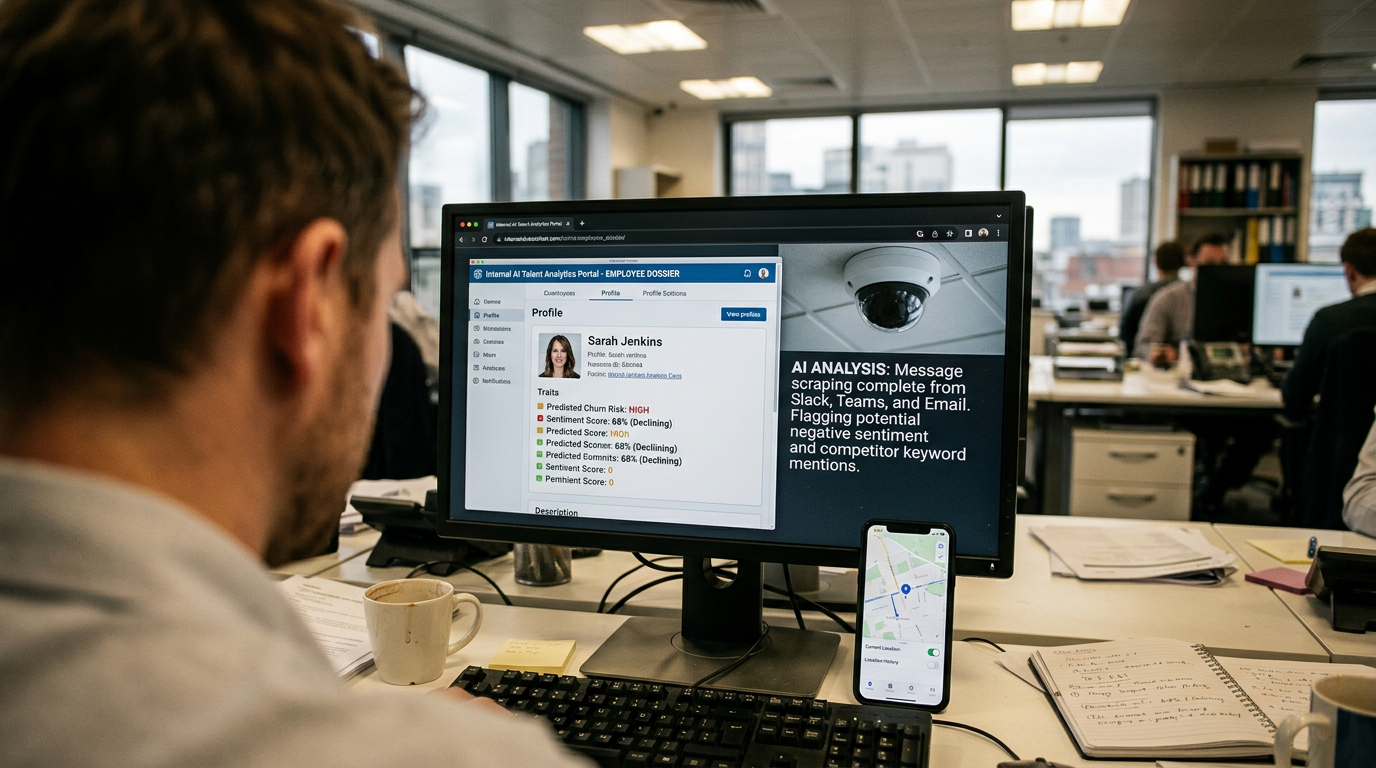
Employers are increasingly using AI and data-driven monitoring to assemble detailed dossiers on workers, drawing scrutiny from privacy experts and raising compliance questions for HR leaders.
On Aug. 15, 2024, an investigation found that organizations are combining location tracking, productivity metrics, camera access and automated scraping of emails and chats to build long-term profiles of employees’ behaviour and performance. The tactics range from logging workstation activity and keystrokes to linking badge swipes and GPS trails with personnel records.
HR and security teams say the tools are positioned as operational and safety measures, intended to track hours, secure buildings and flag risky behaviour. Vendors market analytics platforms that ingest multiple feeds and surface “red flags” or efficiency scores. Employers that use those systems argue they help manage remote and hybrid teams and detect genuine threats to property or data.
Privacy advocates counter that stitching together disparate data points creates portrait-style dossiers that far exceed traditional supervision. Those profiles can include inferred traits, aggregated performance scores and histories of off-hours locations. Experts warn that the mash-up of signals — particularly when algorithms generate inferences — amplifies the risk of misclassification, discrimination and unfair discipline.
State-level legal frameworks are uneven. Some jurisdictions require notice and consent for certain types of monitoring or regulate biometric data; others offer limited protections for employee communications. That patchwork means a practice permitted in one state can face limits or enforcement in another, complicating national HR policies and multisite compliance strategies.
Employment-law specialists say the practical consequences for employers include potential unfair-labour-practice claims if surveillance chills protected activity, discrimination exposure when analytics feed biased decisions, and state statutory claims where notice or biometric rules apply. Labor representatives and privacy groups are already pressing for clearer guardrails and more transparency around how signals are collected and used.
For HR leaders, experts recommend practical steps: map what data is collected and why; document retention periods and access controls; run impact assessments when analytics influence hiring, promotion or discipline; and include monitoring practices in employee handbooks and onboarding. Privacy professionals emphasise that notice alone is not sufficient if employees have no realistic choice but to accept monitoring to keep their jobs.
What wasn’t disclosed in many vendor pitches and employer accounts is granular detail on model governance and independent oversight. Few vendors publicly publish results of bias or accuracy audits, and employers often do not disclose how long aggregated profiles are kept, who within the organisation can query them, or whether outside parties can access the data. Pricing, customer lists and concrete examples of corrective action after false positives are also scarce in public materials.
The trend fits a wider shift in workforce technology: as organisations adopt tools to operate across dispersed teams, those same systems create the data trail that makes portrait-style monitoring possible. Regulators and courts are starting to take note; enforcement actions and litigation that test the boundary between legitimate oversight and unlawful surveillance are likely to follow.
For HR departments, the immediate priority is governance. Building a defensible approach to workplace monitoring — one that documents legitimate business purposes, minimises data collection, protects sensitive categories and provides clear employee notice — will be central to managing both legal risk and trust in the workplace as AI-driven surveillance capabilities continue to spread.