EESC adopts pro-worker AI opinion urging social dialogue
The European Economic and Social Committee endorsed opinions calling for stronger social dialogue, worker involvement and collective‑bargaining coverage of AI rollouts.
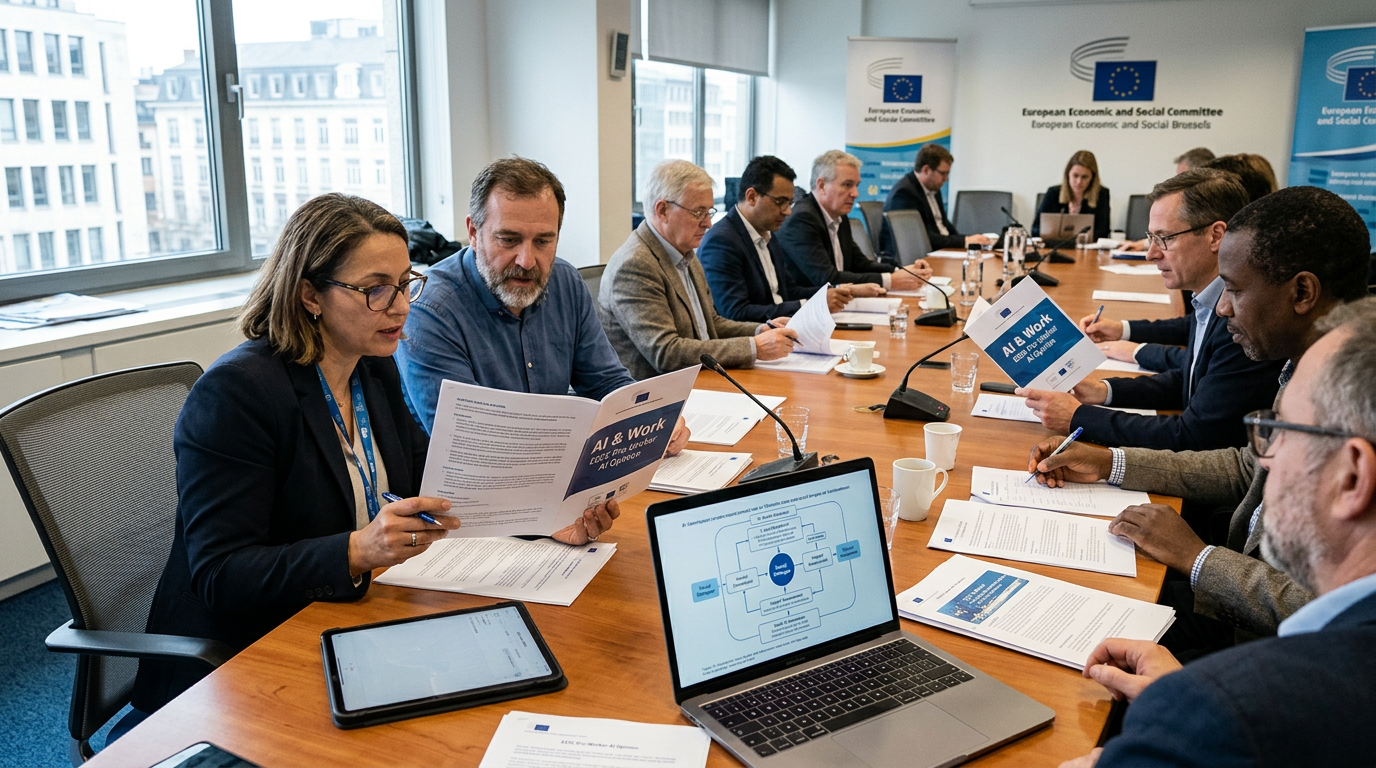
The European Economic and Social Committee adopted a set of "pro‑worker" opinions that press for structured social dialogue, greater worker involvement and collective‑bargaining coverage when employers roll out AI systems.
Published after the EESC's 607th plenary on 15–16 July 2026, the opinions call for explicit protections against algorithmic management and workplace surveillance, and urge coordination between social partners and national AI supervisory authorities as digital tools are deployed across workplaces.
The EESC frames its intervention as a rights‑based approach to workplace AI, arguing that trade unions and employee representatives must be involved early where artificial intelligence touches hiring, performance management, scheduling, monitoring or other people‑analytics functions. The committee recommends that collective bargaining should cover not just conditions of use but also risk assessment, transparency measures and remedies for algorithmic harms.
Alongside demands for bargaining coverage, the opinions warn against unchecked surveillance and automated control mechanisms. They push for safeguards to protect workers' dignity, privacy and health, including limits on continuous monitoring and mandatory human oversight where decisions affect employment status or working conditions. The EESC also advises that national labour inspectors and AI supervisory authorities should coordinate to enforce these protections.
For employers operating in the EU, the guidance puts a spotlight on several practical areas: hiring and screening platforms; automated performance scoring and task allocation; algorithmic shift scheduling; and people analytics that feed managerial decisions. The EESC explicitly links these technologies to collective‑bargaining and consultation rights, signalling that many workplace uses of AI should be matters for negotiation rather than unilateral management choice.
The opinion sits alongside EU legislative developments. While non‑binding, the EESC's stance arrives as member states implement the EU Artificial Intelligence Act and governments prepare national guidance and enforcement frameworks. By urging coordination with national AI authorities, the committee is nudging regulators to treat workplace AI as both a labour and a tech policy issue.
The committee's recommendations are deliberately practical in tone but stop short of laying down operational standards. The opinions do not specify exact thresholds for what constitutes "high risk" in everyday HR tools, nor do they provide model bargaining clauses, audit protocols or technical transparency standards for vendors. They also do not set timelines for when social partners must be engaged or how disputes over algorithmic uses should be resolved at sectoral or company level.
That absence leaves several open questions for employers and HR teams. Companies will need to decide whether to expand consultation processes or offer collective bargaining concessions before systems are piloted; HR leaders will want clarity on what kinds of documentation and impact assessments will satisfy both worker representatives and national supervisors. Vendors of hiring and people‑analytics software are likely to face greater demand for explainability and audit trails, but the EESC does not spell out audit methodologies or accreditation routes.
The opinion is likely to stiffen labour demands during negotiations over digitalisation and create fresh leverage for unions pushing for binding workplace rules on AI. For employers, the practical implication is that integrating AI into HR processes will increasingly be treated as a social‑dialogue issue rather than solely a compliance exercise. As national authorities publish guidance and tribunals begin to interpret the EU AI framework in employment contexts, businesses should expect bargaining tables and supervisory enquiries to shape how, and how quickly, workplace AI is deployed.