California enrolls SB 951 to add AI disclosures to WARN notices
California enrolled SB 951 Aug. 31, 2026, requiring AI-driven layoff notices to list affected classifications, automated job functions and AI vendor details.
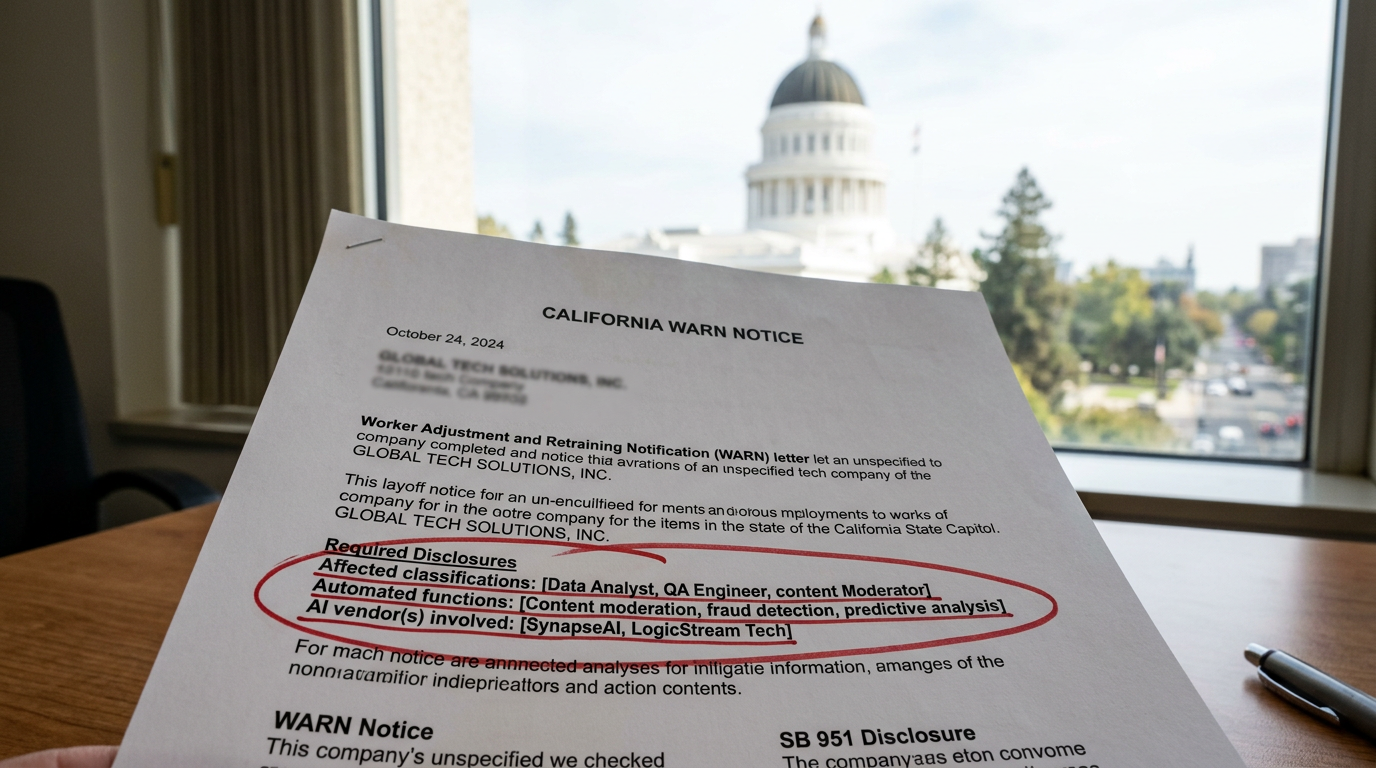
California lawmakers on Aug. 31, 2026 enrolled Senate Bill 951, a measure that would require employers to include specific details about artificial intelligence and automation when giving WARN-style notice for mass layoffs substantially caused by those technologies.
The enrolled bill amends California’s Worker Adjustment and Retraining Notification framework so that an employer issuing a notice tied substantially to AI or automation must identify the number and classification of workers affected, the job functions or tasks being automated, and the category or type of AI system involved — including the developer or vendor, the bill text shows. SB 951 also directs the state’s Employment Development Department to publish summaries of employer notices and to produce quarterly reports on AI-driven worker displacement.
By forcing disclosure of vendor and system information, SB 951 would push employers to document how automation decisions were made and to make that documentation publicly visible to state authorities. HR and legal teams will likely have to coordinate internal inventories of affected roles and track suppliers and models used in production systems to satisfy the disclosure requirements.
The bill’s authors framed the measure as a transparency tool for employees and state agencies. The requirement to report the classification of workers and the job functions targeted by automation gives affected employees and workforce agencies clearer information to guide retraining, job-search assistance and benefit planning, according to the bill language.
For employers, the mandate raises immediate operational and contractual questions. Many vendor agreements and procurement records contain confidentiality clauses or limited disclosure provisions; obligating employers to name developers and vendors in a public notice could force renegotiation of contracts or spur disputes over trade secrets. In addition, HR departments will face practical challenges in determining when a layoff is “substantially caused” by AI rather than other commercial factors — a determination central to whether the enhanced notice duties attach.
The move comes amid heightened regulatory scrutiny of workplace AI across jurisdictions. Lawmakers and agencies have increasingly sought transparency about how automation affects jobs and workplace decision-making, and SB 951 follows that trend by tying disclosure to an existing, enforceable layoff-notice regime rather than creating a standalone reporting program.
What the bill does not spell out is how some of those thorny questions will be resolved in practice. The enrolled text requires system category and vendor identification but does not specify whether employers must disclose technical model details, internal risk assessments, or results of bias audits. It also leaves open how the EDD will present employer summaries, what privacy or trade-secret protections it will apply, and how the state will define the threshold for a layoff to be considered substantially caused by automation.
SB 951 now sits with the governor for signature or veto. If signed, the law would reshape compliance workflows for employers operating in California and place new transparency obligations on relationships between employers and AI vendors. For HR leaders, the change signals a shift from managing automation as an internal operational decision to treating it as a public, reportable action with workforce and regulatory consequences.