Anthropic embeds invisible watermark in Claude for EU AI Act
Anthropic says Claude models from Aug 2, 2026 carry an invisible watermark and C2PA provenance to meet Article 50 transparency under the EU AI Act.
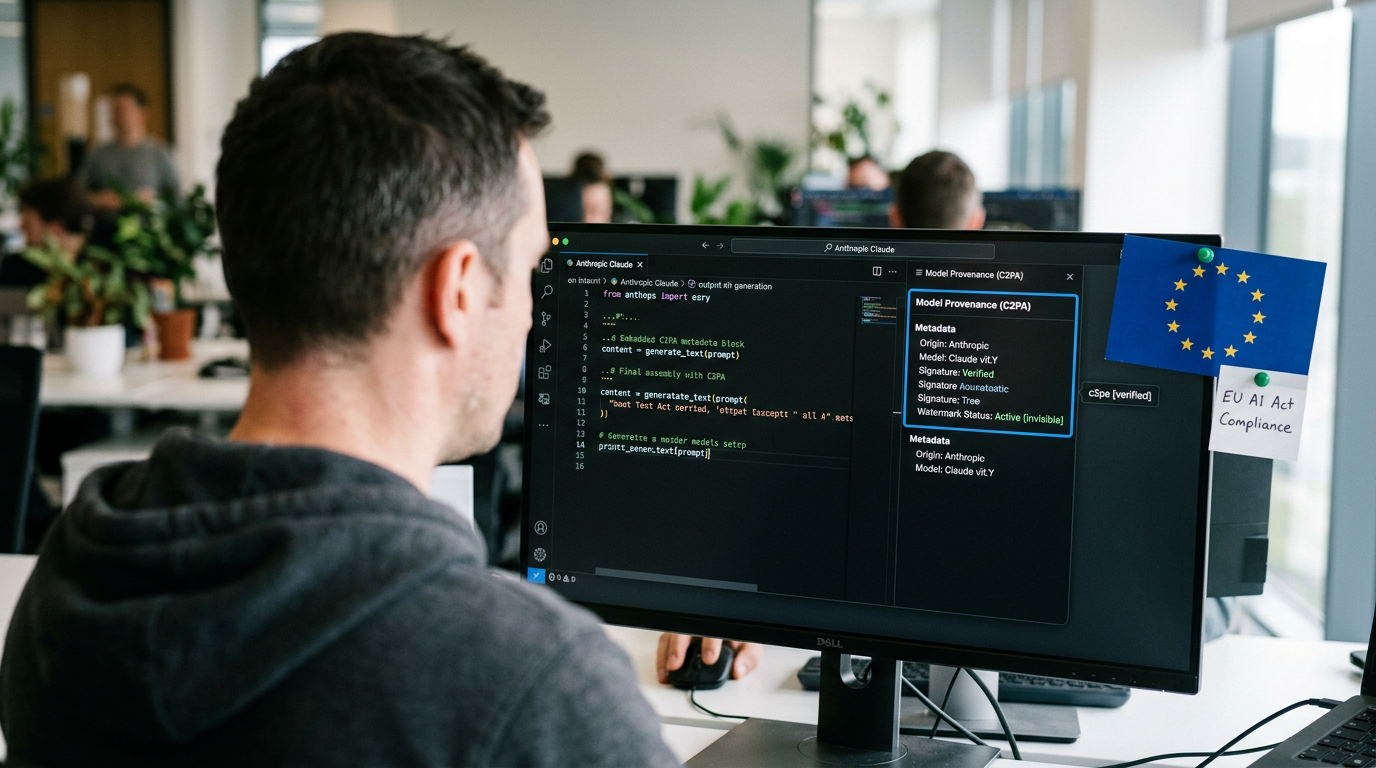
Anthropic has begun embedding machine‑readable marks in outputs from its Claude models to meet the EU AI Act’s transparency obligations. The company announced that models launched from Aug. 2, 2026 carry a statistical, invisible watermark woven into generated text and C2PA‑signed provenance for files, intended to satisfy Article 50 requirements for high‑risk documentation and traceability.
Anthropic’s support documentation sets out the two parts of the marking system: an invisible statistical watermark intended to be detectable by specialised tools and a C2PA provenance payload attached to downloadable files. The firm says the measures are designed to make it possible to identify content produced by Claude and to provide machine‑readable metadata about how a file was created and by which model.
Vendors have been clear that marking is not the same as public labelling. Anthropic and other platform providers are positioning detection APIs and verification tools for downstream services and customers, but outside researchers warn the approach has practical limits. Analyses summarised by technology reporters and independent commentators note that short passages, blocks of code, heavy editing, or translation can defeat statistical watermarks or make detection unreliable.
Those caveats matter for employers. Human resources teams already use generative AI for internal memos, interview questions, job descriptions and candidate communications. If outputs can carry detectable provenance, organisations must think about recordkeeping, disclosure and audit trails — particularly for EU‑based operations where Article 50 creates explicit transparency duties for certain AI systems. That said, HR teams should not assume every piece of text will be unambiguously identifiable as machine‑generated in every circumstance.
The move by Anthropic reflects a wider pattern across the market as regulators tighten rules on generative AI. The EU AI Act, which places new obligations on providers and deployers of certain systems, has pushed vendors to bake compliance features into models and file formats. Other firms have explored watermarks and provenance standards; Anthropic’s public documentation is the clearest example yet of a major model provider adopting both an invisible watermark and C2PA provenance together.
Independent observers emphasise detection gaps. Journalistic and technical writeups identify edge cases where statistical marks are weak or absent — very short outputs, code snippets and content that has been lightly edited or merged with human writing. Security researchers point out that detection thresholds and false‑positive rates will be key to any enforcement regime, and those metrics are not made public by every vendor.
Anthropic has not disclosed several operational details that would affect enterprise use. The company has not published independent test results showing detection accuracy across languages, file types or edited content; it has not clarified whether watermarks apply to private model deployments or on‑premise uses; and there is no public pricing or access model for the promised detection APIs. Nor has Anthropic released third‑party certifications that would validate Article 50 compliance in practice.
For HR leaders, the change is both technical and managerial: provenance markers make it possible in principle to trace certain AI‑generated outputs, but enforcement and real‑world reliability remain contested. As organisations grapple with compliance and trust, employers will need to balance reliance on vendor tools with their own documentation policies and legal advice — especially for regulated hiring processes and sensitive communications where provenance could affect liability and employee relations.