Employment tribunal flags AI‑generated filings in Abraham case
An Employment Tribunal in Abraham v Hound Technology Ltd warned that rapid AI‑assisted reconsideration applications raised procedural and evidential concerns.
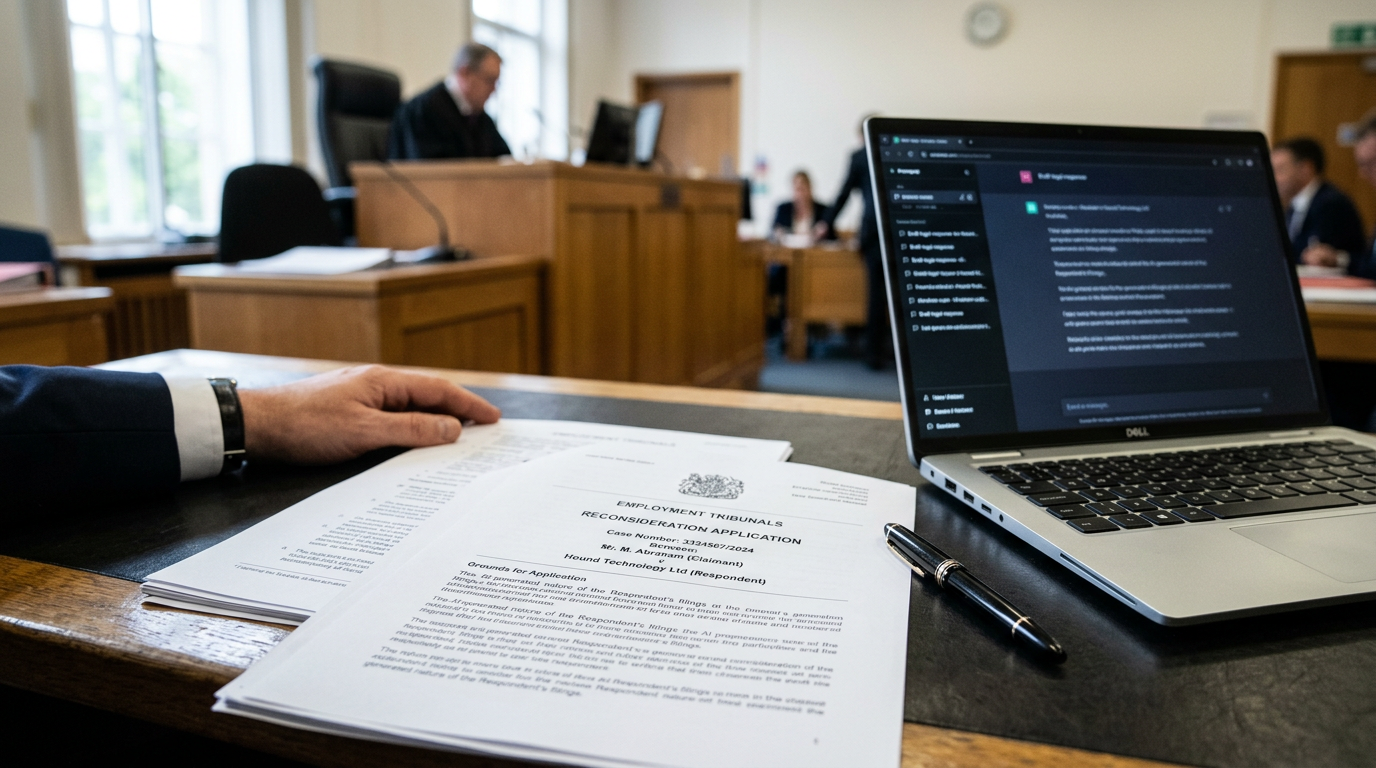
A UK Employment Tribunal has raised sharp procedural and evidential concerns after a claimant submitted reconsideration applications drafted with the assistance of generative AI immediately following an oral judgment in Abraham v Hound Technology Ltd.
In a decision published in June 2024, the tribunal said the speed and form of the applications — lodged within hours of the hearing — meant it could not assume the documents simply reflected the claimant’s own case. The judgment, and subsequent legal commentary, flagged that AI‑generated materials can blur authorship and make it harder for the tribunal to assess whether a party is advancing fresh evidence or recycling points already rejected at hearing.
The tribunal criticised the “rapid series” of applications and emphasised that documents produced or polished by generative tools must “reflect rather than suggest” a party’s case, a phrase the judgment used to underline the difference between assistance and advocacy that substitutes for human decision‑making. The judge ordered procedural steps to clarify who had prepared the documents and what role any AI tool had played, signalling that unexplained machine assistance would not be treated as neutral or automatically authentic.
Legal commentators who analysed the ruling said it is one of the first concrete employment‑tribunal instances in the UK to grapple with how generative AI affects litigation hygiene. The Natural and Artificial Law analysis of the judgment noted the tribunal’s focus on authorship and authenticity, and highlighted the practical problems that arise when a party files multiple, AI‑assisted applications shortly after receiving an oral ruling.
For HR leaders and in‑house counsel, the case is a cautionary illustration of how AI tools used to draft grievance letters, internal tribunal correspondence or litigation submissions can create downstream risks. If AI alters the tone, inserts legal arguments not canvassed at hearing, or produces materials without clear attribution, tribunals may treat those documents with scepticism, require forensic disclosure of prompts or reject them as procedural abuse.
The decision arrives as UK courts and regulators increasingly confront generative AI across sectors. Courts have already begun asking for transparency about the provenance of electronically produced documents; this employment tribunal pushed further by focusing on the timing and rapidity of AI‑assisted filings and requiring parties to explain authorship and the extent of machine involvement.
What wasn’t disclosed in the published ruling — and what commentators say employers should watch for — is the identity of the tools the claimant used, the precise prompts or workflows employed, and whether any third‑party service prepared or reviewed the applications. The tribunal’s orders stop short of prescribing a universal disclosure regime for prompts or models, instead leaving room for case‑by‑case directions; that ambiguity leaves employers and representatives without a clear checklist to satisfy tribunals when they rely on AI.
For HR teams managing employment disputes, the immediate takeaway is procedural: if a party intends to use AI to draft submissions, it should document the process, record who reviewed and adopted the text, and be prepared to produce that information on request. The tribunal’s insistence that documents must reflect — not suggest — a party’s case signals that courts will scrutinise AI’s role where timing or content raises the spectre of unfair surprise.
The Abraham decision is likely to shape how solicitors, claimants and employers approach the use of generative tools in tribunal proceedings and workplace disputes. As AI becomes a routine drafting aid, tribunals will increasingly demand transparency about authorship and may develop rules on the admissibility and treatment of AI‑generated material, forcing HR leaders to reconcile the operational benefits of AI with the evidential standards of employment litigation.